- "Sulphate-free" and "herbal" are two different claims. A shampoo can be one, both, or neither — the front of the bottle will not tell you which.
- Strong cleansers can hide under names that do not contain the word "sulphate". Check the first five ingredients after water, not the front label.
- Use the 7-point checklist at the end before you pay.
Picture this: you are in a shop in Pakistan, or scrolling through an online store, comparing two shampoo bottles. Both have a leaf on the front. Both say "herbal". One also says "sulphate-free" and costs more. Which one do you buy? Neither the leaf nor the price tells you what is actually inside the bottle. Only the ingredient list does — and this guide will teach you how to read it like a buyer, not a chemist.
This is a decision guide, not a chemistry lesson. If you want the full science of what each ingredient does, our herbal shampoo ingredients guide covers that. Here, we focus on choosing a shampoo without being fooled by the packaging.
"Sulphate-free" and "herbal" are two different claims
This is the single most useful thing to understand before you buy. The two words describe completely different things:
- Sulphate-free is about what is not in the shampoo. It means the formula does not use sulphate cleansers such as SLS or SLES. It says nothing about what the shampoo does contain.
- Herbal is about what is in the shampoo — plant ingredients such as amla, hibiscus or shikakai. But there is no strict, widely enforced definition of "herbal" on most labels, so a product can carry the word with only a tiny amount of plant extract.
That gives you four possible combinations, and all four exist on Pakistani shelves:
| With sulphates | Sulphate-free | |
|---|---|---|
| Herbal ingredients | A herbal shampoo that still uses a sulphate cleanser | A herbal shampoo with a mild cleanser — the combination most gentle-wash buyers want |
| No real herbal content | A regular commercial shampoo | A mild shampoo that is sulphate-free but has no meaningful plant ingredients |
So when a bottle says "herbal", ask: herbal and sulphate-free, or herbal with sulphates? And when a bottle says "sulphate-free", ask: sulphate-free and herbal, or just mild? The front label answers neither question. The back label does.
The 2-minute label check
You do not need to understand every chemical name:
- Step 1 — Ignore the front. Put the leaf and the word "herbal" out of your mind for a moment. Marketing lives on the front; facts live on the back.
- Step 2 — Find the full ingredient list. If a shop or listing will not show you the full list before you buy, treat that as a warning sign. A confident brand shows its formula.
- Step 3 — Read the first five ingredients after water. Ingredients are listed from highest to lowest amount. The cleanser is almost always in this first group, and whatever cleanser sits here defines the shampoo more than anything else on the label.
- Step 4 — Look for the herbs, and note where they sit. If a plant extract appears near the end of a long list, it is present in a very small amount. In the first half, it is a real part of the formula.
- Step 5 — Check the size, price and expiry. Compare price per millilitre, not price per bottle. Check the shelf life and batch date, especially in small shops where stock can sit for a long time.
Hidden sulphates: names that do not say "sulphate"
A shampoo can be marketed as gentle while still using a strong cleanser under a name you do not recognise. Watch for these:
- Sodium coco-sulfate. Despite the softer-sounding name, this is a sulphate cleanser. If a bottle claiming to be sulphate-free lists this, the claim does not hold up.
- Ammonium lauryl sulfate. A sulphate, just with ammonium instead of sodium.
- Sodium C14-16 olefin sulfonate. Technically a sulfonate rather than a sulphate, but from the same strong-cleansing family — often used where a brand wants to avoid the word "sulphate".
- TEA-lauryl sulfate and sodium myreth sulfate. Variations on the same theme — if "sulfate" or "sulphate" appears in the cleanser names, the shampoo is not sulphate-free.
The rule is simple: search the ingredient list for "sulf" — that catches sulfate, sulphate and sulfonate in one glance. If nothing matches, and the cleansers are names such as coco glucoside, decyl glucoside or plant saponins from shikakai and reetha, the sulphate-free claim holds up.
Red flags beyond sulphates
Sulphates get all the attention, but check these too:
- Silicones and build-up. Names ending in "-cone", "-conol" or "-siloxane", such as dimethicone, give instant smoothness but can build up over time, leaving hair flat and dull. A silicone-heavy shampoo may occasionally need a stronger wash to remove the build-up.
- Parabens. Names such as methylparaben and propylparaben are preservatives. Regulators in many countries consider them safe at the levels used in cosmetics, but some shoppers prefer to avoid them. The point is to know whether they are there, so the choice is yours.
- Drying alcohols vs fatty alcohols. Alcohol denat can feel drying, but cetyl alcohol and stearyl alcohol are fatty alcohols that actually condition hair. Do not reject a shampoo just for the word "alcohol" — check which kind it is.
- "Fragrance" or "parfum". A single word can cover many scent ingredients. If your scalp is sensitive, a lighter-scented formula is a safer bet, and a patch test on your inner arm for 24 hours is always worth doing with a new shampoo.
- No full list at all. The biggest red flag is not an ingredient — it is the absence of a list. A bottle or listing that hides its ingredients asks you to buy on trust alone. Do not.
"Herbal" marketing tricks to spot
Because "herbal" is a marketing word rather than a guaranteed standard, it gets stretched in predictable ways:
- The leaf on the front. Green packaging, a flower photo and the word "herbal" say nothing about the formula. Judge the back, not the front.
- "With amla" vs amla-based. "With" can mean a tiny amount added for the label. Check where the herb sits — near the top means it matters, at the very end means it is mostly decoration.
- Herbal plus sulphate. A shampoo can be genuinely herbal and still use a strong sulphate cleanser. For gentle washing, you need both claims to be true, not just one.
- One herb, many promises. A single plant extract does not make a complete hair-care solution. Look for a formula where the herbs, the cleanser and the conditioning agents make sense together.
When sulphate-free is NOT the best choice
Sulphate-free is not right for everyone, every time. A stronger wash has its place:
- Very oily scalp or heavy build-up. If you use heavy oils, styling products or silicone serums daily, a mild shampoo may not remove everything. An occasional stronger wash resets the scalp.
- After swimming or heavy sweating. Chlorine, salt and dried sweat sometimes need a stronger cleanse before you return to your gentle routine.
- Medicated needs. If you have persistent dandruff or a scalp condition, a medicated shampoo may be what actually helps — a herbal shampoo is not a treatment. Our dandruff guide explains when to see a doctor instead.
The practical approach for most people: a mild, sulphate-free shampoo for everyday washing, and a stronger wash only when build-up demands it.
The 7-point checklist before you buy
Run through this list in the shop or on the product page. If a shampoo passes all seven, it is a safe buy:
- Is the full ingredient list visible before I pay?
- Is the cleanser in the first five ingredients after water mild — not a sulphate or sulfonate in disguise?
- Do the herbs I care about appear in the first half of the list, not at the very end?
- Are silicones, parabens and fragrance levels acceptable to me — a choice I made, not a surprise?
- Does the price per millilitre make sense against the size of the bottle?
- Is the shelf life and batch date acceptable?
- Does the brand answer questions honestly — for example, what happens if my scalp reacts?
How NB Herbals fits in
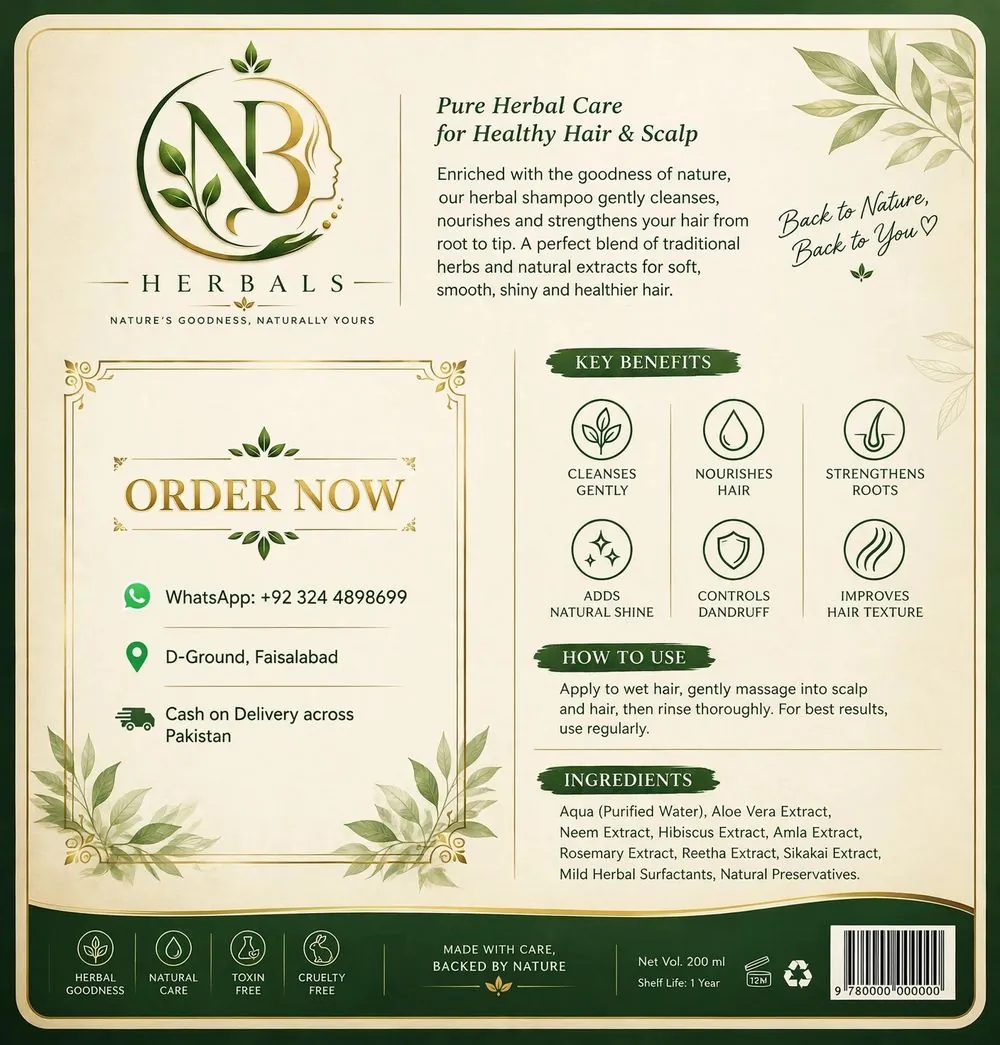
NB Herbals Herbal Shampoo is sulphate-free, and the full ingredient list is printed on the pack so you can run this checklist yourself: amla, hibiscus and shikakai are the herbal core, and the shampoo suits all hair types. It is a 200ml bottle for Rs 899. We do not claim silicone-free or paraben-free until a lab report or supplier sheet confirms them — instead, we show you the list.
Many customers pair the shampoo with NB Herbals Herbal Hair Oil (100ml, Rs 799) as a pre-wash treatment — mustard oil, methi dana, amla, reetha and vitamin E, massaged in before washing. See the shampoo's ingredients and price on the NB Herbals Herbal Shampoo 200ml page, and read the deeper ingredient science in our herbal shampoo ingredients guide.
Frequently asked questions
Is sulphate-free shampoo better than herbal shampoo?
That is the wrong comparison — they measure different things. Sulphate-free describes the cleanser; herbal describes the plant content. The best everyday shampoo for most people is both. Check the label for both, not just one.
Does sulphate-free shampoo clean properly?
Yes, for everyday washing. Gentle cleansers produce a lighter lather than sulphates, but less foam does not mean less cleaning. Heavy build-up may occasionally need a stronger wash — that is normal.
How can I tell if a shampoo is genuinely herbal?
Look at where the herbs sit on the ingredient list. Herbs in the first half are a real part of the formula; herbs at the very end are present in tiny amounts. Also check whether the brand shows the full list before you buy.
Sulphate-free shampoo se baal saaf hotay hain ya nahi?
Ji, rozana dhone ke liye sulphate-free shampoo kaafi hai. Iska jhaag kam hota hai, lekin kam jhaag ka matlab kam safai nahi. Zyada oil ya product jama ho to kabhi kabhi strong wash ki zaroorat par sakti hai.
Herbal likha ho to kya shampoo acha hi hota hai?
Nahi, zaroori nahi. "Herbal" aik marketing lafz bhi ho sakta hai — bottle ke peechay wali ingredient list dekhen. Agar jadi bootiyan list ke aakhir mein hain to woh kam miqdar mein hain. Asal formula wohi hai jo list mein upar likha ho.
Before you buy your next bottle
Next time you pick up a shampoo, flip it over before you pay. Two minutes with the ingredient list will tell you more than any leaf on the front ever will. Try NB Herbals Herbal Shampoo for Rs 899 NB Herbals Herbal Shampoo 200ml, or ask us anything on WhatsApp before you order.
Try the NB Herbals routine
Herbal Shampoo 200ml — Rs 899 · Herbal Hair Oil 100ml — Rs 799. Cash on delivery, order on WhatsApp.