- Ignore front-label buzzwords — the ingredient list (ordered highest to lowest) is the truth.
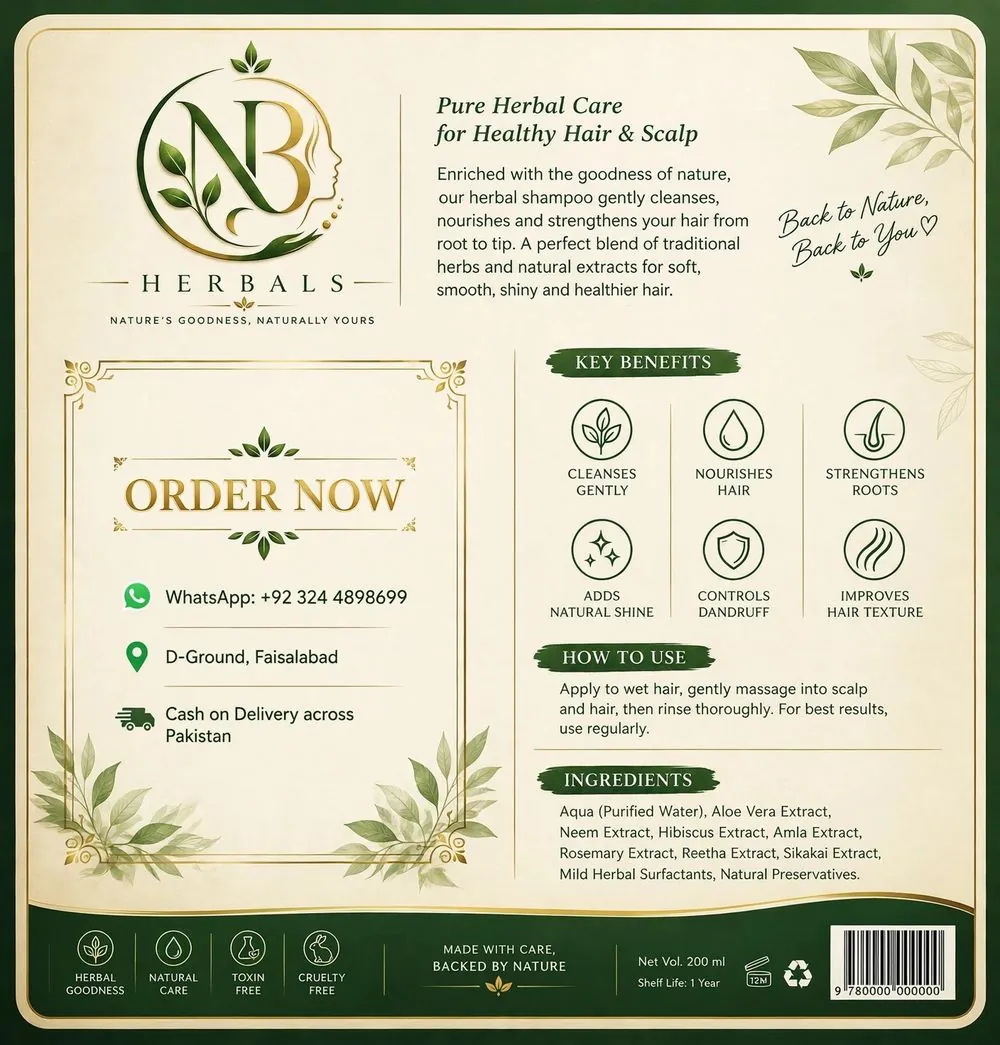
- NB Herbals Herbal Shampoo is sulphate-free; the full ingredient list is printed on the pack.
- Gentle cleansers foam less than sulphates — less foam does not mean less cleaning.
Pick up any shampoo bottle in Pakistan and you will probably see a leaf, a flower or the word "herbal". Turn it over and the ingredient list tells a very different story, often a long list of chemical names that are hard to read. This guide explains herbal shampoo ingredients in plain language, what the common ones actually do, how sulphate-free shampoo differs, and how to read any label so you are never guessing.
What "herbal" really means on a shampoo label
There is no strict legal definition of "herbal" or "natural" on most shampoo labels. A product can contain a small amount of plant extract and still call itself herbal. What matters is what the formula is built on: the cleansing base, how much of the formula is plant-based, and whether the brand is open about it.
So instead of trusting the front of the bottle, flip it over and read the list. A good herbal shampoo should show you recognisable plants, a mild cleanser, and as few unnecessary extras as possible.
The main parts of a shampoo
Almost every shampoo, herbal or not, is made of the same few building blocks:
- Water: the first ingredient on nearly every shampoo, usually written as "aqua".
- Surfactants (cleansers): the ingredients that lift oil and dirt away. This is the most important part of any shampoo.
- Conditioning agents: ingredients that make hair feel smooth. These can be plant oils and extracts, or silicones.
- Active herbs and extracts: the plants that give the shampoo its character.
- Preservatives: any water-based product needs these to stay safe and fresh.
- Fragrance and colour: added for scent and appearance.
Common herbal ingredients and what they do
Amla (Emblica officinalis)
Also called Indian gooseberry, amla is rich in vitamin C and tannins. It is traditionally used to condition hair and add shine.
Shikakai (Acacia concinna)
The name means "fruit for hair". Shikakai contains natural saponins, which cleanse gently and create a mild lather. It is also traditionally used to reduce tangles.
Hibiscus
Hibiscus flowers and leaves contain a slippery, mucilage-like substance traditionally used to soften and condition hair.
Aloe vera, neem and reetha
These three often appear in herbal formulas too. Aloe is used for its soothing feel, neem for its traditional use on the scalp, and reetha (soapnut) as another natural source of saponins.
Rosemary — traditionally used to stimulate the scalp and add volume; also in the NB Herbals shampoo.
Natural vs synthetic: what the words really mean
"Natural" sounds safe and "synthetic" sounds harmful, but neither is true by default. Poison ivy is natural, and plenty of lab-made ingredients are very gentle. Even water is a chemical. What matters is how an ingredient is made, how much of it is in the formula, and how your skin responds to it. A good brand does not hide behind buzzwords. It tells you what each ingredient is for.
Sulphates explained: SLS and SLES
Sodium lauryl sulphate (SLS) and sodium laureth sulphate (SLES) are strong, cheap cleansers that produce thick, satisfying foam. They clean very well. The downside is that for some people, particularly those with dry, sensitive or irritated scalps, they can feel drying or irritating.
This does not make sulphates "toxic" and it does not mean every shampoo containing them is bad. It simply means they are a stronger cleansing choice, and some people prefer something milder.
Sulphate-free vs sulphate shampoos
A sulphate-free shampoo replaces SLS and SLES with gentler cleansers. Common examples you will see on labels include coco glucoside, decyl glucoside, sodium cocoyl isethionate and cocamidopropyl betaine. Plant saponins from shikakai and reetha are also traditional natural cleansers.
If you have a very oily scalp or heavy product build-up, a sulphate shampoo used occasionally can still be useful. Mild shampoos suit everyday washing.
| Shampoo with sulphates | Sulphate-free shampoo | |
|---|---|---|
| Lather | Thick, abundant foam | Lighter, creamier lather |
| Cleansing strength | Very strong | Mild to moderate |
| Scalp feel | Can feel tight or dry on sensitive scalps | Usually gentler |
| Cost | Usually cheaper to make | Often costs a little more |
What we leave out of NB Herbals Herbal Shampoo
Our Herbal Shampoo is sulphate-free, as stated on the packaging. We don’t claim silicone-free or paraben-free until a lab report or supplier sheet confirms them — our full ingredient list is printed on the label and on our ingredients page, so you can check for yourself.
How to read any shampoo label
- Check the order. Ingredients are listed from highest to lowest amount. If herbs appear at the very end of a long list, they are present in tiny amounts.
- Find the cleanser. Look at the first few ingredients after water. Names ending in "sulfate" or "sulphate" are sulphate cleansers. Names with "glucoside" are gentle sugar-based cleansers.
- Spot silicones. Names ending in "-cone", "-conol" or "-siloxane", such as dimethicone, are silicones. They give instant smoothness but can build up over time.
- Understand preservatives. Names like phenoxyethanol or sodium benzoate keep the product safe. A shampoo with water and no preservative is not a good thing.
- Look at fragrance. "Parfum" or "fragrance" can hide many ingredients. If your scalp is sensitive, choose a lighter-scented or fragrance-light formula.
- Ignore front-label buzzwords. Words like "pure", "natural" and "herbal" are marketing, not guarantees.
Questions to ask any herbal shampoo brand
- Can I see the full ingredient list before I buy?
- What is the cleansing base?
- Which herbs are in the formula, and where do they appear on the list?
- How do you support your claims, for example with a lab report or supplier sheet?
- What do I do if my scalp reacts?
A brand that is confident in its formula will answer all five easily.
Frequently asked questions
Is herbal shampoo better than regular shampoo?
Not automatically. A well-made herbal shampoo can be gentler and more pleasant for regular use, but a poorly made one can be just as harsh. The ingredient list tells you far more than the word "herbal".
Are sulphates dangerous?
Sulphates are widely used and are considered safe for most people. They can be drying or irritating for sensitive scalps, which is why some people prefer sulphate-free options.
Why does my herbal shampoo not foam much?
Gentle cleansers produce a lighter lather than sulphates. Less foam does not mean less cleaning.
Can herbal shampoo cause an allergy?
Yes. Plant extracts can cause reactions in some people. Always patch test a new shampoo on your inner arm and wait 24 hours.
Why does a herbal shampoo still need a preservative?
Any product that contains water can grow bacteria and mould, even if it is full of plant extracts. A preservative keeps the shampoo safe through weeks of bathroom use. A herbal shampoo with no preservative at all is a warning sign, not a bonus.
How do I know if a shampoo suits me?
Give it four to six weeks of regular use. A good match leaves your scalp comfortable and your hair clean and manageable, without itching, tightness or heavy build-up.
See what is inside our shampoo
Ready to check an ingredient list that you can actually read? See the full list for NB Herbals Herbal Shampoo 200ml, or browse our herbal shampoo guide herbal shampoo.
Try the NB Herbals routine
Herbal Shampoo 200ml — Rs 899 · Herbal Hair Oil 100ml — Rs 799. Cash on delivery, order on WhatsApp.